
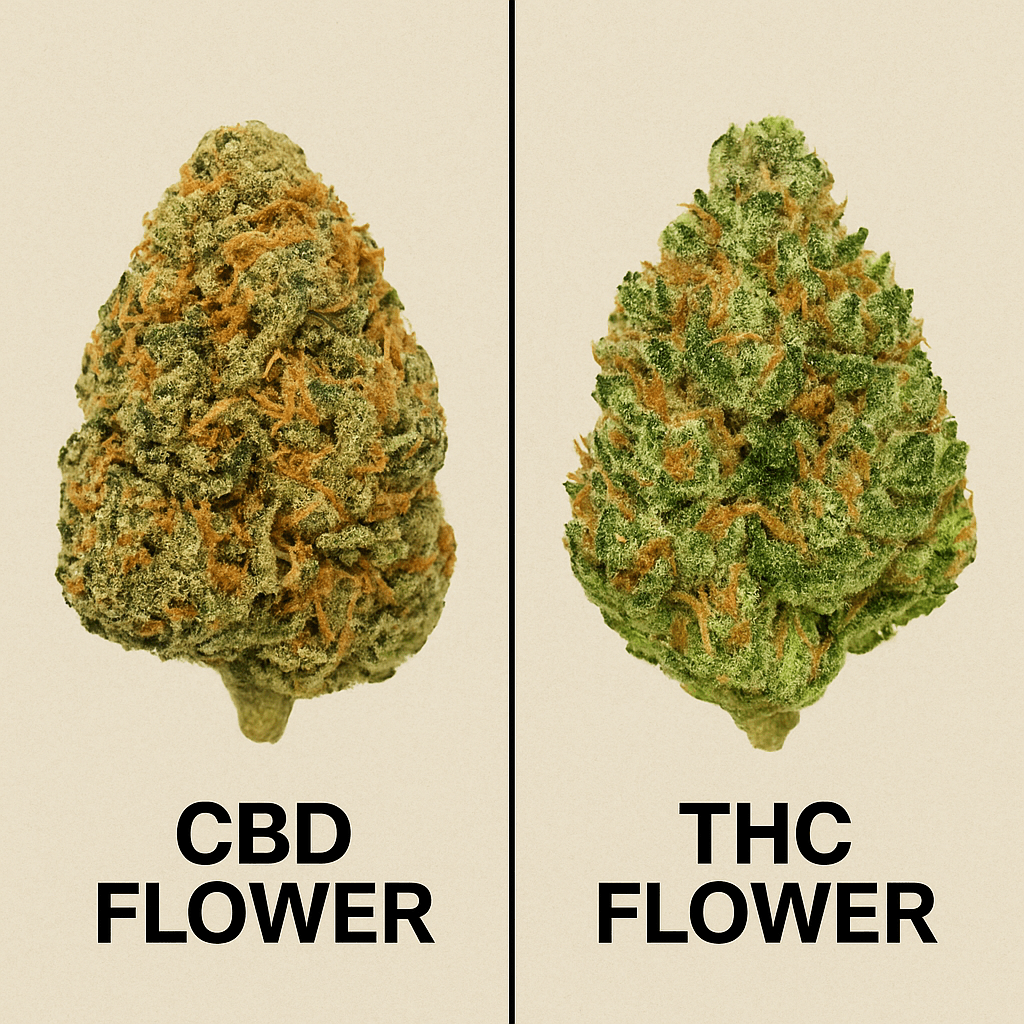
The main difference between CBD flower vs THC flower is their dominant cannabinoid profile. Both can come from Cannabis sativa, but CBD flower is generally selected for higher levels of cannabidiol (CBD) and comparatively low THC, while THC flower is selected for higher levels of delta-9-tetrahydrocannabinol (THC).
That distinction matters because THC is the main cannabinoid associated with cannabis intoxication, whereas CBD does not produce the same characteristic intoxicating effect.
However, the labels “CBD flower” and “THC flower” do not tell you everything about a product. CBD flower is not necessarily THC-free, and THC-dominant flower can still contain CBD and other cannabinoids. Actual concentrations vary by cultivar and batch, which is why accurate cannabinoid information and laboratory documentation matter more than appearance, smell, or marketing terminology.
CBD Flower vs THC Flower: Quick Comparison
| Factor | CBD Flower | THC Flower |
|---|---|---|
| Main cannabinoid | Usually CBD-dominant | Usually THC-dominant |
| Intoxicating potential | CBD itself is not intoxicating in the same way as THC | THC can cause intoxication |
| THC content | Generally comparatively low; varies by product | Usually substantially higher |
| CBD content | Generally higher | Varies considerably |
| Plant species | Cannabis sativa | Cannabis sativa |
| Appearance | Can closely resemble THC-rich cannabis | Can resemble CBD-rich flower |
| Aroma | Depends strongly on terpene profile | Depends strongly on terpene profile |
| Cannabinoid profile | CBD-dominant, often with other cannabinoids | THC-dominant, potentially with other cannabinoids |
| Legal status | Depends on country, composition, and classification | Often subject to stricter controls |
| Laboratory testing | Important for confirming composition | Important for confirming composition and potency |
| Key considerations | CBD/THC content, classification and local rules | THC concentration, impairment and local rules |
The most important takeaway is simple: appearance and smell alone are not reliable ways to distinguish CBD flower from THC flower. Cannabinoid analysis and accurate product information matter more.
Two flowers can look remarkably similar while having substantially different concentrations of CBD and THC.
What Is CBD Flower?
CBD flower is a cannabis flower with a cannabinoid profile that is generally dominated by cannabidiol rather than THC.
It comes from Cannabis sativa, the same plant species associated with many THC-rich cannabis products. The important distinction is not simply the plant’s appearance but its cannabinoid composition.
CBD, or cannabidiol, is one of the naturally occurring cannabinoids found in cannabis. According to the World Health Organization’s information on cannabidiol, pure CBD does not demonstrate the effects associated with abuse or dependence potential that are characteristic of some other controlled substances. WHO has also distinguished cannabidiol from the principal psychoactive constituent of cannabis, THC.
CBD-rich flower can also contain other naturally occurring cannabis compounds, including minor cannabinoids and terpenes.
Terpenes are aromatic compounds that contribute to the distinctive scent of different cannabis varieties. Their presence can explain why two CBD flowers smell different even when their CBD concentrations are similar.
One important distinction is low THC versus zero THC. A product described as CBD flower should not automatically be assumed to contain absolutely no THC. Its actual cannabinoid content depends on the plant, genetics, cultivation, and final product.
For that reason, a reliable cannabinoid analysis is considerably more informative than a product name alone.
What Is THC Flower?
THC flower is cannabis flower with a cannabinoid profile dominated by tetrahydrocannabinol, particularly delta-9-THC.
THC is the principal psychoactive constituent associated with cannabis intoxication. WHO identifies delta-9-THC as the major psychoactive component of cannabis.
THC flower may also contain CBD, other cannabinoids, and terpenes. The relative quantities vary substantially between cultivars and individual products.
THC concentration matters because two THC-dominant flowers can have very different cannabinoid profiles. A product containing a relatively lower percentage of THC is not equivalent to one containing a substantially higher concentration simply because both are called THC flower.
Higher THC concentration should not be interpreted as automatically meaning better quality. Potency and quality are separate characteristics.
THC can affect cognition, perception, coordination, and reaction time, making impairment an important consideration. The European Union Drugs Agency also notes that cannabis contains a wide range of cannabinoids and that its pharmacology is more complex than THC content alone.
CBD Flower vs THC Flower — What’s the Main Difference?
The central difference is the dominant cannabinoid profile.
CBD-rich and THC-rich flowers may share similar plant structures, aromas, and visible characteristics, but their chemical composition can be significantly different.
CBD and THC Content
CBD flower generally contains considerably more CBD relative to THC, while THC flower is selected for higher THC concentrations.
Those are broad category descriptions rather than universal formulas.
Actual percentages depend on factors such as:
- genetics
- cultivar
- cultivation conditions
- harvest timing
- processing
- individual batch
A product specification or reliable laboratory analysis is therefore the better source for determining actual cannabinoid concentrations.
Intoxicating Effects
This is one of the most significant distinctions between CBD and THC.
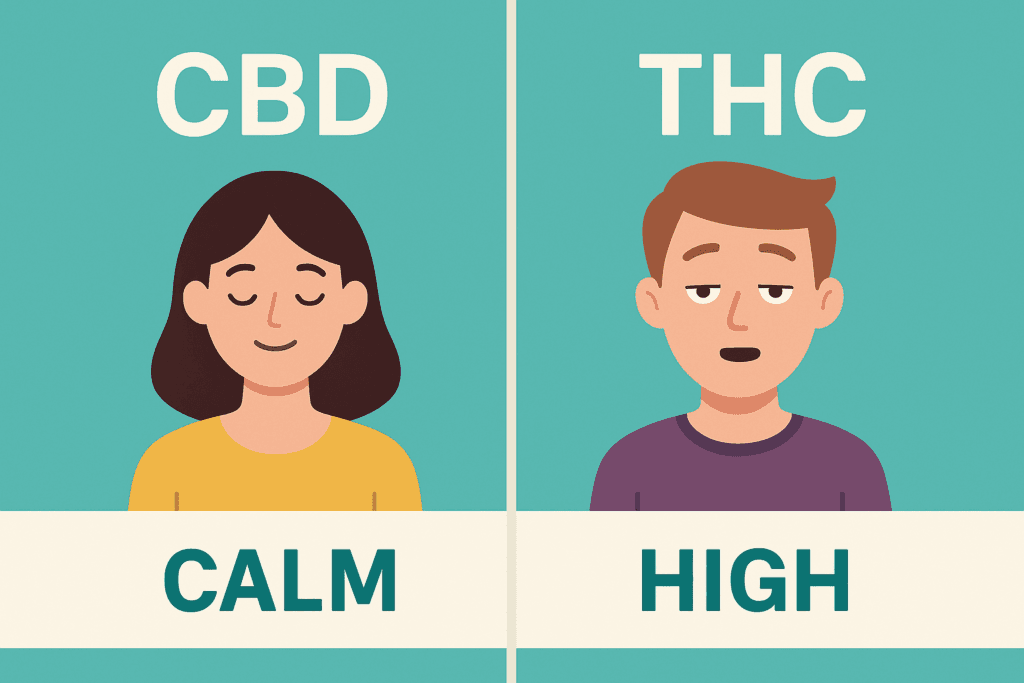
THC is capable of producing intoxication and can alter perception, cognition, and coordination. CBD itself does not produce the same characteristic intoxicating effect.
That does not mean every product carrying the term “CBD” should automatically be treated as THC-free. The complete cannabinoid profile still matters.
Individual responses can also vary, particularly when products contain multiple cannabinoids.
Appearance
Can CBD flower look like THC flower?
Yes.
Both may have similar:
- flower structures
- trichomes
- colours
- pistils
- resinous surfaces
- cultivation characteristics
Visual inspection cannot reliably tell you how much THC or CBD a flower contains.
A dense, heavily trichome-covered flower is not automatically THC-rich, just as a particular colour does not prove that a flower is CBD-dominant.
Aroma and Terpenes
Both CBD and THC flower can produce noticeable cannabis aromas.
The smell comes largely from volatile compounds such as terpenes rather than THC itself. Cannabis varieties may contain different combinations of aromatic compounds, creating earthy, citrus, herbal, floral, fruity, or other profiles.
This makes smell an unreliable method for deciding whether a flower is CBD-rich or THC-rich.
Terpenes are useful for describing aroma, but specific smells should not be treated as evidence of a particular THC percentage or guaranteed health effect.
Cannabinoid Profiles
Cannabis contains more than just CBD and THC.
Other cannabinoids may also be present in smaller quantities, and their concentrations depend on plant genetics and product characteristics.
For this reason, terms such as “CBD flower” and “THC flower” are useful shorthand for the dominant cannabinoid, not complete descriptions of everything found in the flower.
A detailed cannabinoid profile can provide a more accurate picture.
Product Testing
Laboratory analysis can help verify claims that cannot be determined reliably through sight or smell.
Depending on the testing performed, documentation may provide information about:
- CBD concentration
- THC concentration
- other cannabinoids
- batch identity
- contaminants or other quality parameters
The scope of testing matters. A laboratory report should not be assumed to confirm something that was never tested.
Batch-specific documentation is also more useful than a generic report that cannot clearly be connected to the product being assessed.
Does CBD Flower Contain THC?
Yes, CBD flower can contain THC.
CBD-dominant does not automatically mean THC-free.
The amount can vary according to plant genetics, cultivation, product specifications, and regulatory requirements. Different products can therefore have different CBD-to-THC ratios.
This is why distinguishing between low THC and zero THC matters.
A flower containing a comparatively small amount of THC is not chemically identical to a product in which THC is absent or below the relevant detection threshold.
Consumers should check actual cannabinoid information rather than assuming that the word “CBD” guarantees zero THC.
Does THC Flower Contain CBD?
It can.
THC flower is defined mainly by its THC-dominant profile, not by the complete absence of CBD.
Some THC-rich cultivars contain relatively little CBD, while others may contain more noticeable quantities. Additional minor cannabinoids can also be present.
This means two products with similar THC concentrations may still have different overall cannabinoid profiles.
For accurate comparisons, examine the complete laboratory information when available rather than focusing exclusively on a single headline percentage.
CBD vs THC: How Are the Cannabinoids Different?
CBD stands for cannabidiol, while THC commonly refers to delta-9-tetrahydrocannabinol.
Both are cannabinoids associated with cannabis, but they interact differently with biological systems and do not produce identical effects.
THC is well known for its psychoactive and intoxicating properties. CBD does not produce the characteristic cannabis intoxication associated with THC.
The body’s endocannabinoid system includes cannabinoid receptors and signalling molecules involved in numerous physiological processes. THC has significant activity at cannabinoid receptors, particularly CB1 receptors, which helps explain its psychoactive properties.
CBD has a more complex pharmacological profile and should not simply be described as “THC without the high.”
For readers interested in a broader evidence-based overview, the NCCIH overview of cannabis and cannabinoids discusses THC, CBD, cannabis research, and areas where scientific evidence remains limited.
CBD Flower vs THC Flower Effects
The effects associated with CBD flower and THC flower cannot be predicted purely from their names.
THC-rich cannabis can cause intoxication and may affect perception, attention, memory, judgement, coordination, and reaction time. The extent varies according to the product, THC concentration, and individual factors.
CBD has a different pharmacological profile and does not cause the characteristic THC-type intoxication by itself.
However, comparing effects involves more than asking whether CBD or THC is present.
Relevant variables include:
- cannabinoid concentration
- overall cannabinoid profile
- product composition
- individual sensitivity
- health factors
- concurrent medications or substances
Scientific evidence around cannabis and individual cannabinoids also varies considerably depending on the particular condition, formulation, and research question. NCCIH notes that evidence for many claimed cannabis or cannabinoid health applications remains limited or at an early stage.
Neither CBD nor THC should therefore be presented as providing guaranteed outcomes.
Can You Tell CBD Flower From THC Flower by Looking at It?
Not reliably.
CBD flower can look almost identical to THC-rich cannabis.
Both may have dense buds, visible trichomes, and similar colour patterns. Genetics and cultivation practices affect these characteristics, but they do not allow an observer to calculate cannabinoid percentages visually.
The same problem applies to labels such as “hemp-looking” or “strong-looking cannabis.” These are not scientific measurements.
If distinguishing the two matters, cannabinoid information and appropriate laboratory analysis are more dependable than visual inspection.
Does CBD Flower Smell Like THC Flower?
It can.
CBD flower and THC flower may have very similar aromas because the smell of cannabis is influenced heavily by terpenes and other volatile compounds.
A CBD-dominant cultivar may therefore smell more similar to a particular THC-dominant cultivar than it does to another CBD flower.
THC itself is not a reliable aroma marker that allows someone to smell a flower and determine its potency.
Consequently, neither aroma intensity nor a particular scent profile can establish whether a flower has high CBD or high THC.
CBD Flower vs THC Flower for Beginners
For beginners, understanding the label is more useful than trying to identify cannabis flower by appearance.
Before comparing products, look at:
- Which cannabinoid is dominant
- actual CBD percentage
- actual THC percentage
- whether THC can produce impairment
- available laboratory documentation
- batch information
- intended product classification
- local requirements
Readers unfamiliar with basic terminology can use this cannabis beginner guide to understand common cannabis concepts before comparing individual product types.
Beginners should be particularly careful not to assume that CBD and THC flower are interchangeable.
A visually similar flower can have a substantially different cannabinoid profile, and THC-rich products introduce additional considerations around intoxication and impairment.
Is CBD Flower Legal in Europe?
There is no single answer that applies identically to every CBD flower product throughout Europe.
European countries can treat cannabis-derived products differently depending on their characteristics and national regulatory frameworks.
Relevant factors can include:
- THC concentration
- cannabis variety
- product classification
- intended use
- national cannabis rules
- import and export requirements
This means a CBD product permitted under one country’s framework should not automatically be assumed to have identical status in another.
The European Union Drugs Agency information on cannabis provides scientific and regulatory context on cannabis at the European level, but consumers should still verify the current rules that apply to their specific country and product.
Is THC Flower Legal in Europe?
THC-rich cannabis is also regulated differently across European jurisdictions.
There is no single Europe-wide retail framework under which recreational THC flower can simply be treated the same way in every country.
National approaches can differ considerably. Depending on the jurisdiction, laws may distinguish between possession, home cultivation, medical access, non-profit or association-based models, commercial supply, and other activities.
EUDA’s 2026 reporting continues to describe cannabis policy and availability as differing across European countries.
A change in the law of one country should therefore never be interpreted as establishing unrestricted commercial sales or cross-border movement throughout Europe.
Current national requirements should always be checked separately.
CBD Flower vs THC Flower — Which Is Better?
Neither is universally “better.”
They are different product categories with different cannabinoid profiles and practical considerations.
CBD flower may be more relevant when researching:
- CBD-dominant cannabinoid profiles
- comparatively low THC levels
- non-intoxicating CBD characteristics
- Hemp and cannabis flower composition
- terpene and cannabinoid profiles
THC flower raises additional considerations around:
- intoxication
- impairment
- THC concentration
- driving
- workplace policies
- individual sensitivity
- national legal restrictions
Higher THC does not equal higher quality.
Likewise, higher CBD content does not automatically prove that a flower has superior quality.
Quality needs to be assessed using appropriate information about composition, handling, batch traceability, and testing rather than one cannabinoid percentage alone.
What Should You Check Before Comparing Cannabis Flower?
1. CBD Percentage
Check the stated CBD concentration rather than relying only on terms such as “CBD-rich.”
A measurable percentage provides more information than a marketing description.
2. THC Percentage
THC concentration is one of the most important factors separating CBD-dominant from THC-dominant flower.
It is also relevant to intoxicating potential and regulatory classification.
3. Cannabinoid Profile
Where reliable testing is available, look beyond CBD and THC.
Cannabis contains multiple cannabinoids, and products with similar CBD or THC numbers can still have different overall profiles.
4. Laboratory Documentation
Check whether laboratory documentation can be clearly connected to the product and batch.
Look at what the laboratory actually tested rather than assuming every certificate covers potency, contaminants, and every other quality measure.
5. Product Classification
Understand how the flower is classified and what its stated intended use is.
This can be important because regulatory treatment may vary between product categories.
6. Batch Information
Batch identification improves traceability.
It can also help determine whether laboratory documentation actually corresponds to the product being evaluated.
7. Supplier Transparency
Useful product information should include measurable specifications rather than depending entirely on terms such as “premium,” “powerful,” or “strongest.”
Transparency makes comparison easier.
8. Local Regulations
Finally, check the current rules for the jurisdiction in which the product is being purchased or possessed.
Do not assume a rule applying to one European country applies automatically across the EU or wider Europe.
Frequently Asked Questions
What is the difference between CBD flower and THC flower?
CBD flower is generally dominated by cannabidiol and contains comparatively low THC, while THC flower has a THC-dominant cannabinoid profile. THC can produce intoxication, whereas CBD does not cause the same characteristic intoxicating effect. Both types of flower can contain multiple cannabinoids and may look and smell very similar.
Does CBD flower contain THC?
CBD flower can contain THC. “CBD-dominant” and “THC-free” do not mean the same thing. Actual THC concentration varies by genetics, cultivation, and product, so consumers should check cannabinoid information instead of assuming every CBD flower contains zero THC.
Does THC flower contain CBD?
Yes, THC flower can contain CBD. THC-dominant simply means THC is a prominent cannabinoid in the product; it does not mean CBD and all other cannabinoids are absent. The ratio varies between cultivars and batches.
Can you tell CBD flower from THC flower by looking at it?
Not reliably. CBD and THC flower can have very similar buds, trichomes, colours, and other visual characteristics. Appearance cannot accurately determine CBD or THC percentages. Appropriate cannabinoid testing provides much more useful information.
Does CBD flower smell like THC flower?
It can. Both CBD and THC flower contain aromatic compounds such as terpenes, meaning their scent profiles can overlap substantially. Smell is not a dependable way to determine whether a flower is CBD-dominant or THC-dominant.
Is CBD flower intoxicating?
CBD itself does not produce the characteristic intoxication associated with THC. However, CBD flower can contain some THC, depending on the product. Its complete cannabinoid profile should therefore be checked rather than assuming every CBD-labelled flower is completely THC-free.
Which is stronger, CBD flower or THC flower?
“Stronger” depends on what is being measured. THC flower generally has greater intoxicating potential because of its higher THC concentration. CBD flower may contain a higher CBD percentage, but CBD does not produce the same characteristic THC intoxication. Cannabinoid percentages are more meaningful than the word “strong.”
CBD Flower vs THC Flower: The Bottom Line
When comparing CBD flower vs THC flower, the most important distinction is cannabinoid composition.
CBD flower is generally CBD-dominant with comparatively low THC, while THC flower contains substantially more THC and has intoxicating potential.
Beyond that basic distinction, the two can be surprisingly difficult to separate visually. Both come from cannabis, can develop similar flower structures and trichomes, and may share overlapping terpene-driven aromas.
That is why appearance and smell are poor substitutes for actual cannabinoid information.
Consumers comparing cannabis flower should focus on CBD and THC percentages, the broader cannabinoid profile, batch-specific testing, product classification, and transparent product information. European consumers should also consider the rules applying to the specific product in their jurisdiction rather than assuming one country’s approach applies throughout Europe.
Ultimately, CBD flower vs THC flower is a comparison of chemical profiles, not simply two different-looking plants. Accurate labelling and credible cannabinoid analysis provide a much clearer answer than appearance, assumptions, or marketing terminology.
Suggested Excerpt:
CBD flower and THC flower can look and smell remarkably similar, but their cannabinoid profiles are very different. Compare CBD and THC content, intoxicating potential, testing, practical considerations, and European regulatory differences.